


SRB | ENG
To the peoples who defend waters, life, and each other,
On October 6th 2024, at a mass demonstration in Berlin under the title “Palestine Resists”, i was arrested about 10 minutes upon my arrival. Numerous policemen suddenly surrounded me. One grabbed my left arm and performed a so-called “pain grip” – bending my left hand towards the inside of my forearm, squeezing everything together with the joint, therefore causing me incredible and unnatural pain, under the claim that i would otherwise resist. They dragged me into a police van, assuming that a banner i was holding in my hand contained a “forbidden terrorist slogan” and warned me that they “have Russian-speaking colleagues who can easily check what it means”.
The “problematic” slogan was written in Cyrillic, one of the scripts of my mother tongue. Cyrillic is a common Eurasian script that was developed in the Balkans in the 9th century and it also happens to be one of the officially recognized scripts of the European Union. The slogan, to the surprise of the ignorant Berlin policemen who decided to release me about 15 minutes later, was not written in Russian, but in my native, polycentric language (please read https://www.krokodil.rs/eng/text-of-the-declaration-on-common-language-in-english/ and sign https://docs.google.com/forms/d/e/1FAIpQLSehdzg3-9KB0sdNdWxCg92B8gfqVE3Md9EwVnEkIFbIL0-6Yg/viewform?c=0&w=1 the Declaration on the Common Language). They will check, they warned me.
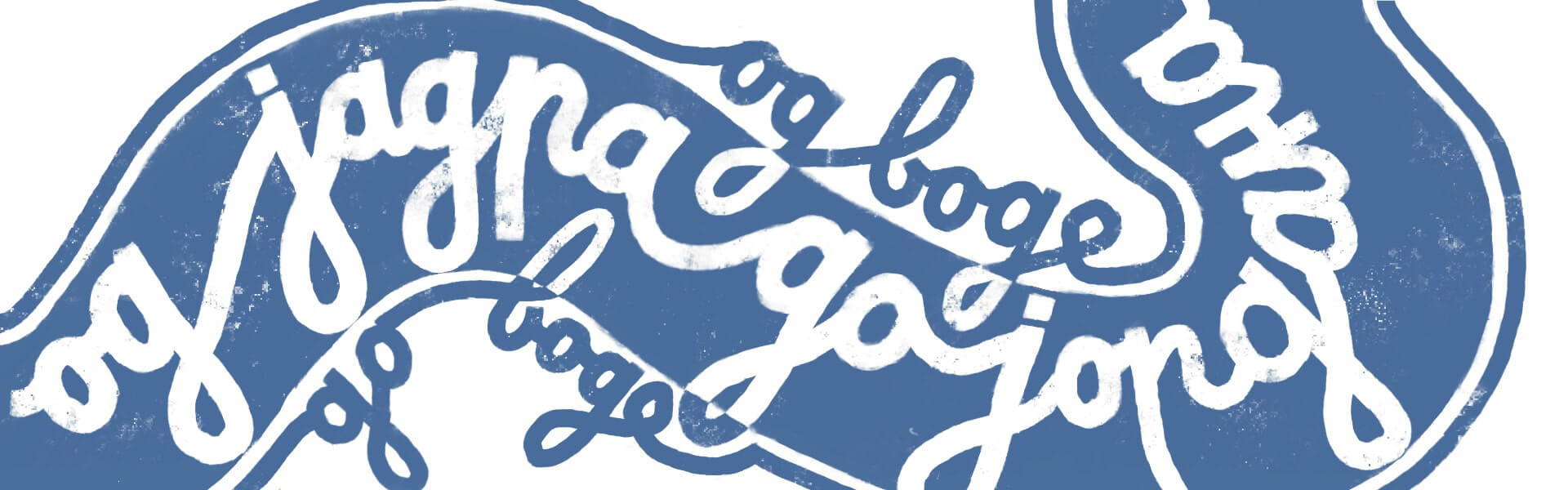
I wrote the protest slogan together with my mother, who came to visit me in Berlin for my birthday. In our language, it says “Од воде до воде, од Јадра до Јордана – подршка!”. The literal English translation of the slogan would be “From water to water, from Jadar to Jordan – support!” We then joined the walk to mark a year of horrific devastation in occupied Palestine.
In the past few years in Serbia, where i grew up, there have been regular protests against the multinational mining company Rio Tinto, which proudly advertises on its website its centuries-long history of environmental degradation around the world, mainly in the “global south” (see the company’s website https://www.riotinto.com/en/about). Recently, protests have grown from a local initiative in the Jadar Valley, where Rio Tinto, the Serbian government, and the German government are pushing to mine for the mineral jadarite, to nationwide mass demonstrations under the initiative “Jadar against Rio Tinto”. The local population is totally opposed to this lithium mining project, and rejects any idea of extraction, from nationalizing it, to giving the Rio Tinto company a free hand to do what the Serbian government and local mining companies are unable to do due to the lack of technology. The message is simple: We do not want anyone digging here!
The “Red River”, as Rio Tinto’s original name translates into English, is a highly toxic river in Spain, where the company opened its first mine. If we follow the slogan of the initiative, in opposition to this company stands Jadar, a local river that would be the first major body of water directly affected by this violent mining project. Undoubtedly, it is not only the water that would be affected, but the whole ecosystem, and here i am not referring only to material, but also to immaterial ecologies. But even if we would focus on water only, and then try to think of water in material terms only – the Jadar River flows into the Drina River, the Drina into the Sava, the Sava into the Danube, the Danube into the Black Sea. Should people whose lives are tied to the Danube not be concerned? Is it any news that German garbage ends up choking the coasts of Indonesia, its weapons in Saudi Arabia, or its young citizens spending their “savings” on six-month colonial vacations in “cheap” countries whose economies and livelihoods their and other imperialist governments have all but exhausted?
On the other hand, are the governments of “developing countries” not following these patterns of profit? Is it not the Krušik Holding Corporation, a factory located in the valley surrounded by mountains, near my birthplace in Western Serbia, the one that produces weapons proven to have been delivered to Iraq, Ukraine, ISIS in Yemen, the Indonesian State Intelligence Agency’s war on West Papua, or to Israeli military planes flying over Gaza? The information on the factory’s website (https://www.krusik.rs/index.php/about-us) proudly states: “We have sold over 15 million items in 70 countries without claims”.
From our home on the mountain slopes above the town where the factory is located, i watched Krušik being heavily bombed by NATO in 1999. More than 90 percent of the factory complex was destroyed. Yet it is one of the few state-owned factories to have miraculously recovered through the post-communist penetration of capital. It received more than 14 million euros from the Serbian government during the last modernization investment cycle only, and is fully supported by the Ministry of Defense of the Republic of Serbia (see the company’s website https://www.krusik.rs/index.php/news/346-factory-anniversary-2).
All this official data can be easily accessed. What cannot be easily accessed is the knowledge i carry just because i happened to spend my childhood in that particular locality. The factory name is a wonderful testimony to the fact that, before it was established under the name of Vistad [vistad] in 1939 and then nationalised under the name Krušik in 1948, what stood at this site was most likely a pear orchard, or a wild pear grove, which is what the word krušik literally means. The factory name does not necessarily give a clue to corporate people in Belgrade, the capital of Serbia, whose lives may be far removed from many krušiks in the mountains, such as the one where i had to lead sheep to pasture, the krušik where my brother saw a dangerous snake in our village, the krušik where we went to pick zelje (a variety of wild spinach), or the krušik where i fell from the cherry tree and ran away happily as if nothing had happened. Similarly, corporate acronyms like CEO, HR or PR do not ring a bell in my family.
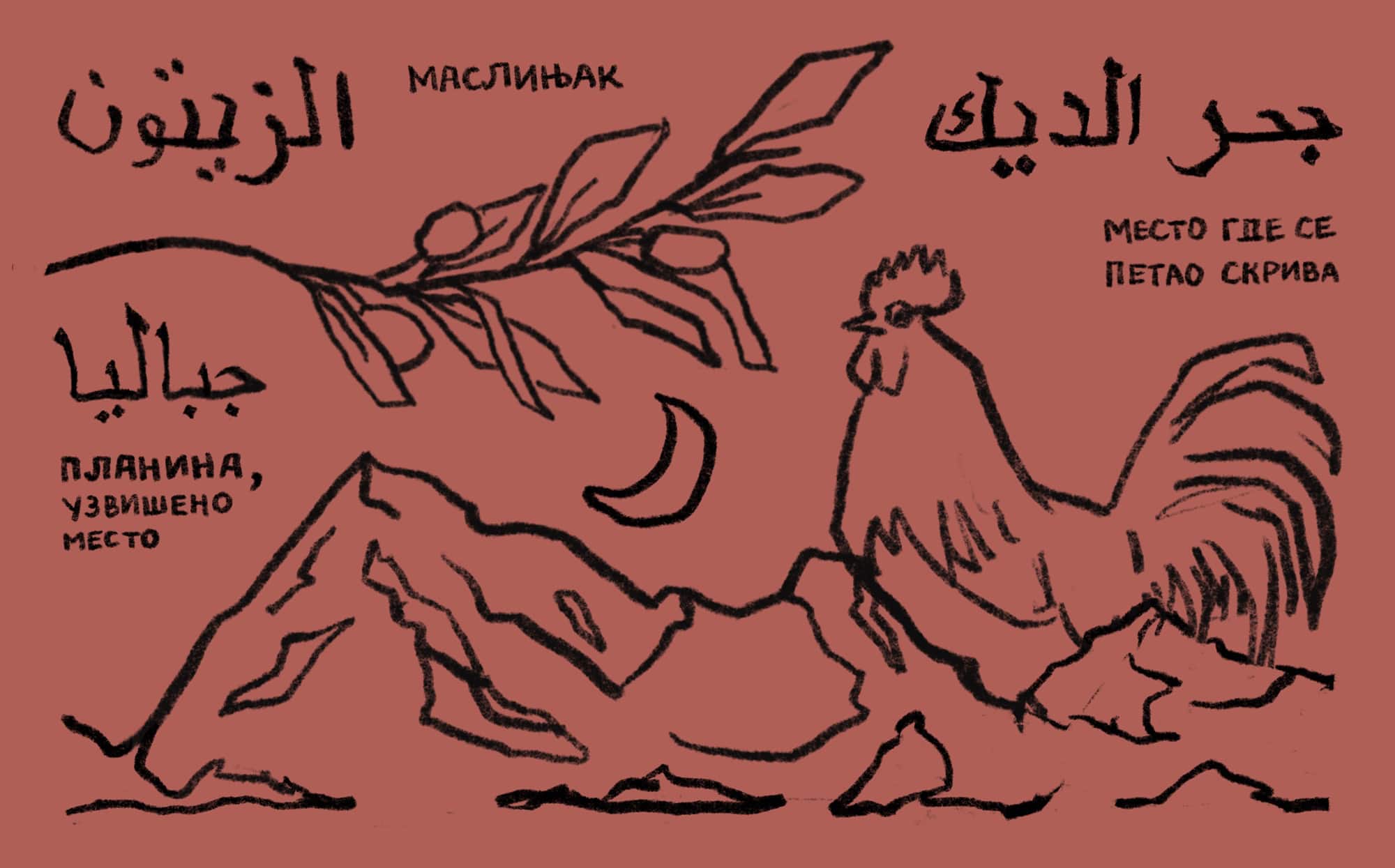
In this context, i ask now: What is Jabalia? To the speakers of Arabic, this would not be hard to guess, although many might not think about it – it would have something to do with a mountain, or a hill. And even if today the mountain is nowhere to be found, the name of the city offers a clue to a story. Sometimes, even though such stories are not being told anymore, people still know them intuitively, in a more assumptive way. There is so much more to places than we might know and, on the other hand, there is much more we know than the conventions allow us to say.
I spoked with my beloved, who is from Syria, asking to help me a bit with these assumptive meanings, or rather past stories of places, without using any “official historical data”, relying only on his intuitive knowledge that comes with the language he grew up within. So, جباليا (Jabalia) evokes a mountain, an elevated place. الزيتون (Zeitoun): an olive grove. المغراقة (Al Mughraqa) suggests that, long time ago, this terrain may have been submerged, sunken. البريج (Bureij) evokes an image of a tower; المُصَدّر (Al Musaddar) of a source, a spring; الشاطئ (Al-Shati) of a beach. وحش (Wahsh) is a ghost, an evil animal that eats people, a beast; and جحر الديك (Juhor ad Dik) a place where rooster hides. دير البلح (Deir Al Balah): a Church located where dates grow, القرارة (Al Qarara): a low-lying place where water rushes in and settles.
Most of the places that contain the word “beit”, which means “a house”, indicate that a person or a family used to live there and their house would serve as a landmark for the community. For example, بيت لاهيا (Beit Lahiya) could mean that a person named Lahiya, most likely in a Christian family, had lived there a long time ago. It could also mean a house of God. بيت حانون (Beit Hanoun) is the house of Hanoun. خربة العدس (Khirbat al-Adas) is an old barn for lentils. خربت اخذا (Khirbat Ikhza’a), and also, خزاعة (Khuza’a) are the remains of an old building. خان يونس (Khan Younis) is Younis’s sheepfold. وادي السلقا (Wadi as Salqa) is Salqa family walley; القرية السويدية (Al Qarya as Suwaydiya) – a Swedish village. النصيرات (As Sureij), a common family name, means “a gate”.
النصيرات (Nuseirat) refers to Christian women, البَيُوك (Al Bayuk) to a grain and animal food merchant, الفَخّاري (Al Fukhkhari) to a potter. الزهراء (Al Zahra’) honors Fatima Zahra’, the daughter of the Prophet Mohammad, مغازي (Maghazi) is a popular name meaning: in sum, the moral of the story. غزة (Gaza), a powerful, strong, special, amazing, magical city, or الضفة الغربية (the west bank) of the Jordan River – none of the places i listed in previous paragraphs are upper- and lower-case Latin letters in my text, on Google Maps or, much less, on military maps.
Going back to the meaning of my slogan, i absolutely reject any interpretation by the German authorities, as i consider them incompetent to provide knowledge or understand context on this matter. Translators are not competent in interpreting my context either, since they, again, do not share my experiences and knowledges. The German authorities are light years away from understanding what my slogan means and to them Jadar, Krušik, and Jordan are most likely terms in Latin script read and understood with an almighty disembodied eye floating imperiously over a map of the world. They also put zero efforts in understanding it and learning from it. Instead, an ignorant and violent external context was applied, aiming to put a chain on my brain.
My mother and I are not brilliant scientists steeped in historical discourse or well-versed in geo-political theories. We wanted to emphasize that extreme violence we witness in Palestine at this very moment is of direct concern to us, and that we do not only empathize, but experience multidimensional belonging to the struggle for Palestinian liberation. People all over the world, especially those whose lives are with the land in all its senses and with each other, wield wondrous knowledges of kin and connection, which state authorities can only understand on their own terms as properties, ownerships, or nationalities. Among the people however, these views are still not fully accepted, or shared and understood in such way. No authority, no state, no multinational corporation can dictate or destroy the existent bonds and relationships between beings, for we are all entangled in ways that cannot be proven with a document, or described in a concise way. Transgenerational experiences and memories, lived and passed on from one being to another, can.
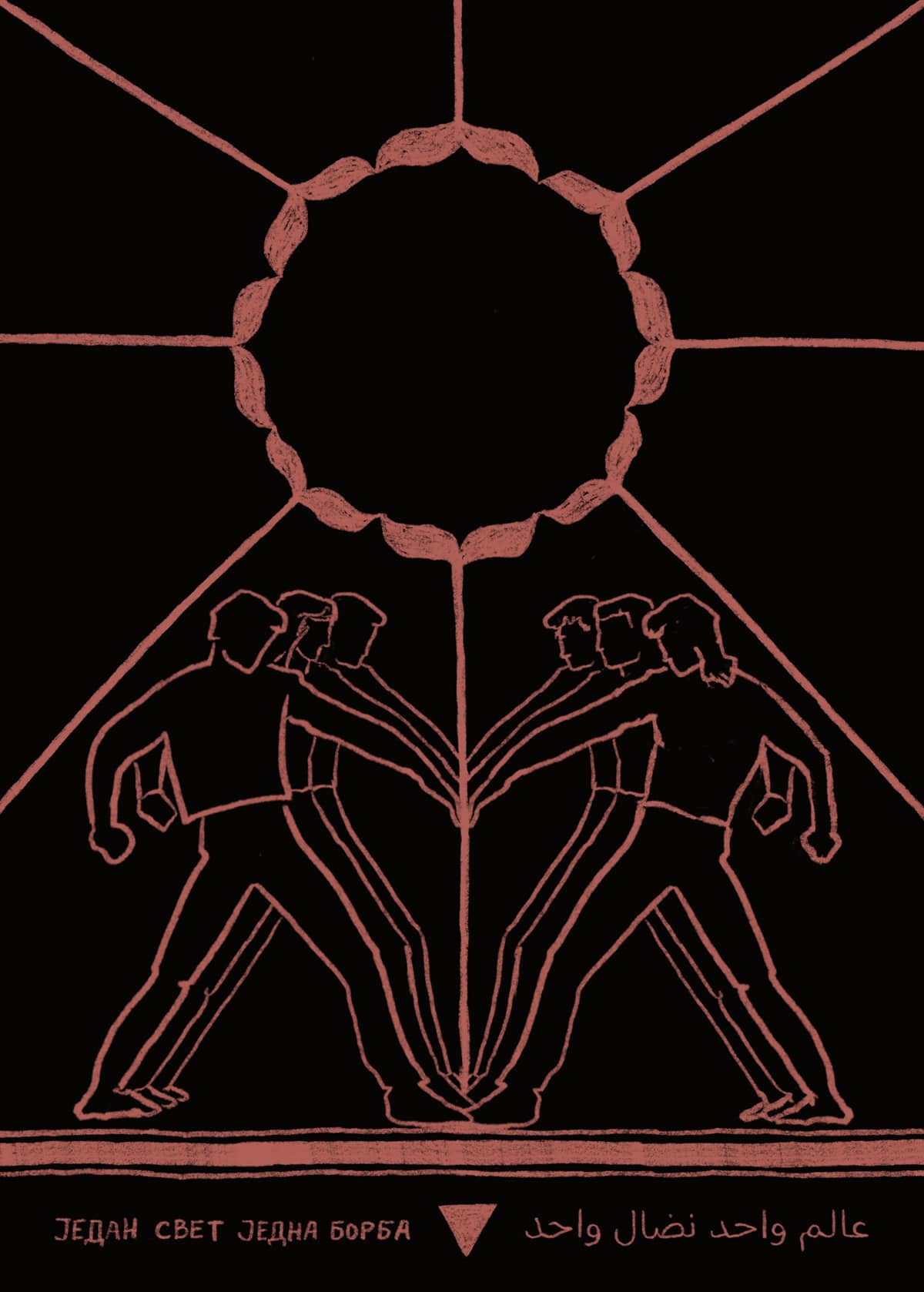
We also did not intend to make comparisons to the level of human suffering of the Palestinian people, who have been living under violent occupation and unjust conditions for decades, both in ancestral homes or exiled homes. Rather, we were referring to the act of resistance by the peoples of the land and waters. We see no discrepancy between ecological protests and protests against genocide, since both reject the same cruel and unjust destruction of ecologies, be it through outright bombing, forced displacement of existing beings, theft of land, violent infrastructure projects, enforcement of historical or religious narratives, to name just a few of the most common methods.
The German state plays an actively aggressive role in all these matters, does so at the expense of the planet, putting us all at gun point. To power its much-vaunted electric car industry, Germany relies on supply contracts for lithium from Serbia because, ironically, it does not have the technology to extract it within its own holy borders without causing untold environmental damage. Germany is a war profiteering and increasingly authoritarian state that allows itself to change laws and interpret histories to the benefit of its economy (e.g. by enforcing a definition of anti-Semitism that ensures Germany’s successful arms trade with Israel, thereby blurring its own terrible histories of racist governance).
Serbian state follows the same destructive pattern. In its desperate race to join the promised land called the European Union and advance within the capitalist mega-order, Serbia is today nothing but a brutal internal colonizer – a subset actor in the major power set of colonial extraction. Numerous local corrupt actors and members of the ruling party, individuals who are sometimes our uncles and cousins, are just outstretched patriarchal arms of that same evil machine. While their illegal companies perform daily explosions in Majdan, a mountain quarry above my parents’ house, to extract construction material; when, as a consequence of this, micro dust blankets the village; while we inhale it, when the whole village rises and protests; when our brave neighbor Slobodanka (whose name means Freedom in our language) receives a death threat on the phone, we know that we are only one out of many Majdans in this world and one of many ecologies at the core of the colonial super set.
Words we encounter in protests are written and spoken thoughts far older than political partitions and geopolitical ideas coming from the top or borders we see on Google maps. They spring from small bodies which collectively form vast multi-scalar spirits and intelligences. Imperialist regimes can do everything in their power to subjugate people and take advantage of lives and words, but kinships move past and beyond their logics. As two of the creatures of the mountains surrounding Jadar, my mother and i pour forth our calls of solidarity and believe it flows toward Jabalia. From water to water, from Jadar to Jordan, to Jaba and Kawerong, to Ambavarano, Besaron, and Lanirano, to Nechako, to Mississippi, to rain and clouds, and to all watery bodies that carry memories of enslavement and violence, but also reflect the vision of a world beyond it – all creatures will be free!
Autorka teksta: Jelena Golubović
Ilustracije: Đorđe Vidojević (Za slobodnu Palestinu)

0 Comments