


Sooner or later, every newcomer to Belgrade learns Đurđevdan. Goran Bregović’s 1988 song, recorded with Bijelo Dugme, is sung at weddings, in kafanas well after midnight, by taxi drivers and by strangers who notice that you know the chorus and decide, on that basis alone, that you are no longer entirely a foreigner. Knowing the words is not integration. But it is a gesture, and gestures are where belonging tends to begin. It is also worth remembering that Đurđevdan is itself a borrowed song: a Serbian reworking of Ederlezi, the Romani melody for the spring feast of St George. Its fame rests on the fact that it changed languages and lost nothing in the crossing.
I thought of this when I came across a live recording of Cennet — Ferhat Göçer’s 2007 Turkish ballad — performed by a singer from Kazan with nothing but a piano behind him. Serbia, it turned out, is next on his map. Ramil Aimetdinov is something of a household name in Tatarstan, but he is not trying to become a Turkish pop star. What he is doing is quieter and, in its way, more unusual: building a career on the principle that a guest should sing in the language of his host.
“Wherever I perform — in France, Germany, China or anywhere else — I try to sing at least one song in the language of the country that is receiving me,” he says. “For me, it is a sign of respect for the culture and for the people who come to listen.” By his own count, his repertoire now spans seventeen languages: Tatar and Russian; English, French, Italian and Spanish; but also Belarusian, Azerbaijani, Kazakh, Georgian, Buryat, Turkmen, Uzbek, Hebrew, Arabic, Turkish and Chinese.
Lists like this are easy to admire and just as easy to dismiss — the polyglot repertoire is a familiar novelty. What separates Aimetdinov’s approach from a party trick is the labour behind it, which he describes in almost artisanal terms. For every new language, he works with a native speaker. “If I am going to sing in Chinese, I look for someone for whom Chinese is the mother tongue, and together we work on pronunciation, intonation, the sound of the words,” he says. “It matters to me not simply to learn the text, but to deliver the song as faithfully and carefully as the original deserves.” With Arabic or Chinese material, the work extends beyond phonetics into the music itself: the way sound is produced, the colour of the line, the logic of the melisma. In his practice, pronunciation is a form of courtesy.
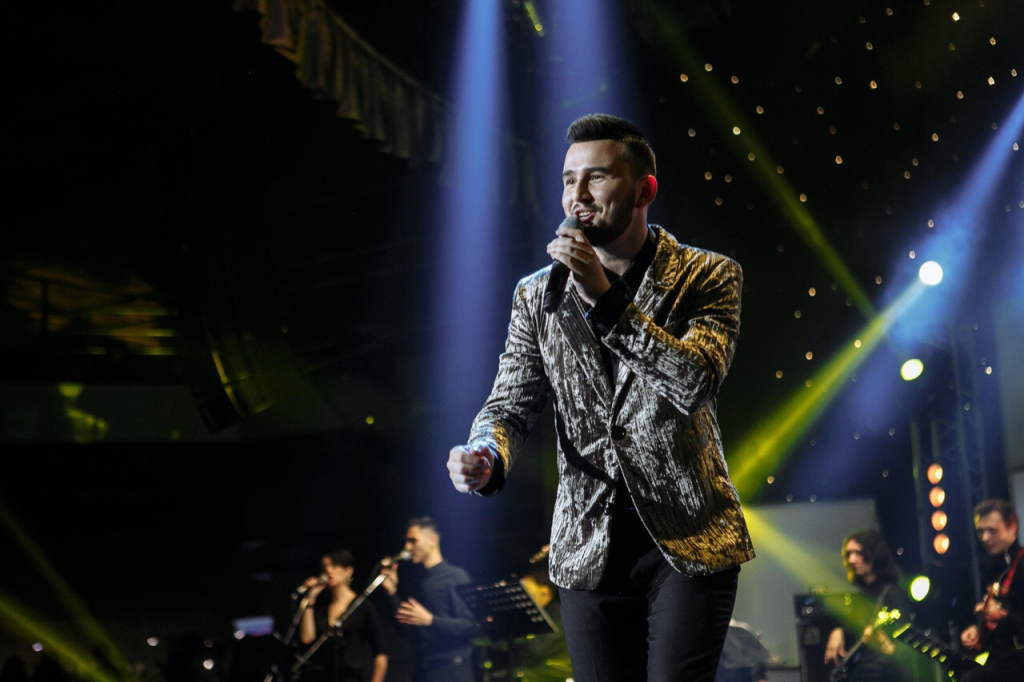
The route to this was not an obviously cosmopolitan one. Aimetdinov comes from Ulyanovsk, a Volga city better known as Lenin’s birthplace than as a musical crossroads, and appeared in 2008 on Minuta Slavy, the Russian edition of the Got Talent format. He began studying Tatar singing at fifteen with Alfiya Ramazanova, an Honoured Artist of Tatarstan, with whom he would later share the stage. Kazan’s Tatar-language estrada — a world of radio-station galas, televised New Year variety shows and touring revues through Almetyevsk, Naberezhnye Chelny and Ufa — became his professional school. In 2018 the music channel TMTV named him its most stylish performer, an award that says something about the scene’s priorities, and something about his.
It is the Sabantuy, however, that explains the shape of his career. The Tatar summer festival, which once marked the end of the spring sowing with wrestling, horse races and songs, has become the portable homeland of a scattered people: Tatar communities stage it wherever they have settled, and Aimetdinov has followed it across a remarkable map. Paris and Geneva; Yuzhno-Sakhalinsk, on Russia’s Pacific edge; Kyzylorda and Aktobe in Kazakhstan; Cento in northern Italy; Vienna. In June 2026 he sang at Sabantuys in Taldykorgan and Almaty, where, according to the Kazakh newspaper Novoe Pokolenie, he surprised the audience by moving between Chinese, Turkish and Georgian, and threw himself into Kazakh songs with particular enthusiasm. A period of living in Germany added German to the list — and, one suspects, a sharper understanding of what it means to stand on a stage as the visitor.
At these festivals his courtesy runs in two directions at once. For the diaspora, there are Tatar songs — the sound of a home that many in the crowd have not lived in for years, or ever. For the hosts, the people whose city has lent the community a park for the afternoon, there is a song in their own language. It is a small piece of diplomacy, conducted entirely through vowels.
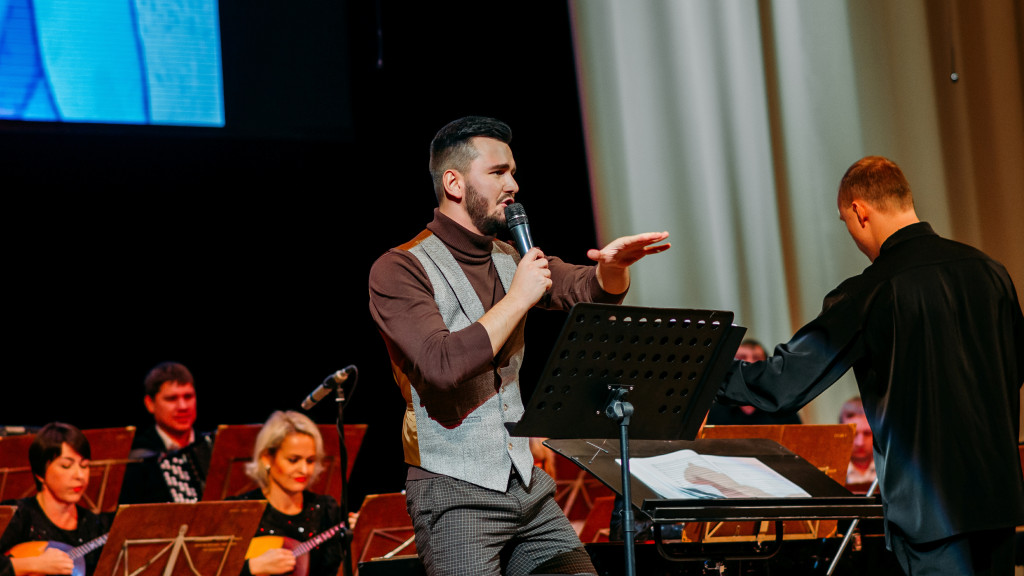
The same instinct — music as a way of being somewhere you are not — shapes the part of his work he holds closest. French chanson, he notes, is rarely heard on Russian stages now, though for an older generation the songs of Édith Piaf, Mireille Mathieu, Charles Aznavour and Dalida are bound up with youth, romance and an entire era. In March 2022 he presented a programme of foreign and Russian twentieth-century pop with an orchestra conducted by Artem Kazantsev at the Sozvezdie-Yoldyzlyk Art Residence in Kazan, singing in French, English, Spanish, Italian, Kazakh, Georgian and Azerbaijani. The city newspaper Kazanskie Vedomosti reported a full hall and quoted the orchestra’s backing vocalist on how joyful the collaboration had been, and on the care Aimetdinov took to explain the meaning behind each song. In March 2026 he returned to the same stage with Melodies of Love, a programme built around Mathieu, Joe Dassin, Piaf and the orchestral world of Paul Mauriat. Mathieu, he says, is his central inspiration; he has seen her in concert twice and, on one occasion, was able to meet her and sing for her.
After one of these concerts, he recalls, a woman came up to him. “I haven’t been to Paris for a long time,” she told him. “But tonight, thanks to you and your voice, I was there.” It is the kind of compliment singers collect and repeat, and it would be easy to treat it as sentiment. But it describes something precise. Nostalgia is usually framed as a longing for a time; this was a longing for a place, satisfied — briefly, and entirely through sound — by a Tatar singer from the Volga who had learned to pronounce Paris correctly.
That precision depends on the room. Aimetdinov works only with live accompaniment and talks about it less as a preference than as a creative principle. “It is not just singing a song over an accompaniment,” he says. “It is a real interaction with the musicians, where everyone brings their own energy and we create something together. Every performance becomes its own moment.” The Cennet recording makes the case quietly. Stripped back to voice and piano, the song — a number-one hit in Turkey on its release — becomes, as the culture site Lokall put it, “a more intimate perspective”: verses held close, a chorus that opens into something brighter, and a delivery calm enough to let the vulnerability of the original through.
None of this is the stuff of streaming charts. Aimetdinov’s career is built on halls in Kazan, festival stages in Kazakh parks and community gatherings in German towns — the unglamorous infrastructure through which most of the world’s music actually reaches its listeners. But there is a coherence to it that a great deal of more visible work lacks. Every element points in the same direction: the native-speaker coaching, the live band, the Sabantuy circuit, the chanson that turns a concert hall in Kazan into Paris for an evening.
Which brings me back to Belgrade, the city Aimetdinov is now looking towards. Đurđevdan has not entered his repertoire yet, but I suspect it is only a matter of time. For Russians arriving in Serbia, it is one of the first pieces of local culture they learn to recognise: the melody reaches them through cinema long before they cross the border, and then meets them again in the kafanas and on the radio. And it is precisely his kind of song: a melody that has already travelled between languages and arrived with its dignity intact. In a world that has grown expert at closing borders, a singer who learns his hosts’ vowels before he unpacks his suitcase offers something small and stubbornly old-fashioned: proof that the guest has been listening.
Srpsku verziju teksta možete pročitati ovde.
Nikolai Grunin is a music journalist and critic based in Belgrade. His work has appeared in Forbes Russia, Esquire Russia, and a number of other Russian and international publications.



0 Comments